
Advantage Plumbing Plus, LLC
Water Softener Services in Wausau, WI
Hard water can leave mineral scale on faucets and showerheads, create spotting on dishes and glassware, affect soap performance, and contribute to buildup inside water-using equipment. Advantage Plumbing Plus provides water softener services in Wausau, WI for homeowners, property managers, and qualifying properties that need help evaluating an existing system or planning a new water-softening solution.
The right approach depends on more than simply choosing a softener from a product list. Water source, hardness concerns, household usage, existing plumbing, equipment condition, available installation space, drain access, and the way the property uses water can all influence the service plan. For properties supplied by a private well, our well pump services can also help when pressure or water-supply conditions need to be considered separately from water treatment.
Call 715-359-7473 to discuss the water conditions you are experiencing and request a project-specific estimate for water softener service in Wausau.
Get Your Free Quote
Tell us what is happening and we will help
Complete Water Softener Service
A useful water-softener service starts with understanding what the property owner is noticing and what equipment is already installed.
Some customers contact us because mineral deposits repeatedly appear on plumbing fixtures. Others notice cloudy glassware, soap residue, changing equipment performance, or an older softener that no longer seems to provide the same results.
The service plan should consider the actual water concern together with the existing softener, accessible plumbing connections, controls, salt or brine system where applicable, drain arrangement, bypass setup, and installation location.
Depending on the condition found and the project goal, the appropriate next step may involve service to an existing unit, replacement planning, a new installation, connection changes, or maintenance guidance.
What Is Hard Water?
Hard water contains dissolved minerals, primarily calcium and magnesium. These minerals are naturally present in many water supplies and can remain behind as scale when water is heated or evaporates.
The effects may be most noticeable around faucets, showerheads, sinks, tubs, glassware, and other surfaces that regularly contact water.
Hardness can also affect how soaps and detergents behave. More product may be needed to create the same lather, and mineral residue can contribute to film on fixtures, dishes, or other surfaces.
A water softener is designed to address hardness minerals. That is different from treating every possible water-quality issue, which is why the property’s actual concern should be identified before selecting equipment.
Signs You May Have Hard Water
Hard water does not always present itself as a single obvious problem. The same property may show several small signs over time.
White or chalky mineral deposits around faucets and showerheads can indicate hardness-related scale. Repeated spotting on glassware, residue around sinks or showers, and soap that does not lather as expected may also justify evaluating the water.
Water-using equipment can provide additional clues. Mineral accumulation can affect components that regularly heat or move water, although a performance problem should still be diagnosed rather than automatically blamed on hardness.
If hard-water buildup appears to be affecting hot-water equipment, our water heater repair services can help evaluate the heater separately from the water-softening system.
How a Water Softener Works
A conventional water softener typically uses ion exchange to reduce calcium and magnesium from the water supply.
Inside the treatment tank, resin media interacts with hardness minerals as water passes through the system. Over time, the system goes through a regeneration cycle that refreshes the resin so it can continue treating incoming water.
Salt-based systems commonly use a separate brine tank as part of this regeneration process. The exact configuration, control method, regeneration settings, and capacity depend on the equipment installed.
Understanding this process is useful because a softener problem may involve more than the treatment tank itself. Salt condition, brine operation, controls, bypass position, drain flow, resin condition, plumbing connections, and settings can all influence system performance.
Existing Water Softener Not Working Properly?
A softener that once performed well can gradually become less effective.
A property owner may notice that mineral scale has returned, soap behaves differently, the brine tank looks unusual, salt consumption changes, regeneration seems inconsistent, or treated water no longer feels the same.
These observations do not automatically mean the entire system needs replacement.
The existing equipment should be reviewed together with its age, condition, controls, accessible plumbing, bypass arrangement, brine components, maintenance history, and current water concerns.
A repair or service adjustment may be practical when the core equipment remains usable. Replacement becomes more relevant when the unit is deteriorated, repair needs are recurring, compatible components are difficult to justify, or the system no longer meets the property’s water-conditioning requirements.
Water Softener Repair or Replacement?
Repair and replacement should be treated as two possible outcomes of the same evaluation rather than predetermined recommendations.
Repair may make sense when the issue is limited to a serviceable component, control setting, connection, brine-related condition, or another correctable part of an otherwise usable system.
Replacement deserves consideration when the equipment has extensive deterioration, recurring service problems, significant age-related wear, outdated controls, unsuitable capacity, or a repair cost that no longer makes sense for the expected remaining service life.
The property’s needs may also have changed. A system originally sized for a smaller household or different water usage pattern may no longer be suitable after changes to occupancy, fixtures, appliances, or building use.
The goal is to recommend the next step based on the equipment and property rather than assuming every older softener must be replaced.
Planning a New Water Softener Installation
A new water softener should be planned around both the water and the plumbing system.
Equipment sizing can depend on hardness conditions, expected water usage, household size, regeneration requirements, available space, plumbing layout, and other system-specific factors.
Installation planning should also account for the main water line, bypass arrangement, shutoffs, drain requirements, power access where applicable, and future service access.
A system that physically fits into a mechanical room is not necessarily the right system for the property. The goal is to plan capacity and connections so the equipment matches actual water-conditioning needs and remains practical to maintain.
For remodeling projects where plumbing locations are changing, our plumbing remodeling services can help coordinate the softener with other planned plumbing work.
Whole-Home Water Softener Systems
A whole-home softener is generally installed where it can treat the appropriate incoming water supply before that water reaches the fixtures and equipment intended to receive softened water.
The exact connection point depends on the property layout and plumbing plan.
Certain outdoor faucets, irrigation lines, drinking-water fixtures, or specialized connections may be handled differently depending on how the property is designed and how the owner wants the system configured.
This is why installation should begin with an understanding of which water lines should receive softened water instead of assuming every branch should automatically be treated in the same way.
Salt-Based Water Softeners and Water Conditioners
Traditional salt-based water softeners and salt-free conditioning systems should not be treated as interchangeable products.
A conventional ion-exchange softener reduces hardness minerals such as calcium and magnesium from the treated water. Other conditioning technologies may be designed primarily to alter how minerals behave or reduce scale formation rather than producing the same type of softened water.
The appropriate choice depends on what the customer is trying to accomplish, the water conditions, property setup, maintenance expectations, and equipment available for the project.
Advantage Plumbing Plus should avoid recommending one technology simply because it is marketed as newer or more advanced. The system needs to match the actual water concern.
Water Softener Service for Private-Well Properties
Private-well properties require the water supply and water treatment system to be considered as related but separate parts of the overall system.
A water softener cannot correct a failed well pump, unstable pressure, pressure-tank issue, or other water-supply problem.
Likewise, a properly operating well does not automatically address hardness minerals or other water-quality concerns.
When a Wausau-area property uses a private well, understanding the source, pressure conditions, existing treatment equipment, and plumbing arrangement can help separate the water-supply issue from the water-conditioning issue.
If water pressure, cycling, or supply reliability is part of the problem, review our well pump services as a related but separate service.
Water Softeners and Water Heaters
Water softeners and water heaters serve different purposes, but water quality can influence hot-water equipment over time.
Hardness minerals can contribute to scale in equipment that repeatedly heats water. Reducing hardness may help limit future mineral accumulation, but installing a softener does not repair an existing heater problem.
If a water heater is already leaking, producing inconsistent temperatures, making unusual sounds, or failing to provide enough hot water, the equipment should be evaluated separately.
Advantage Plumbing Plus provides both water heater repair and water heater installation when a hot-water issue needs attention in addition to water conditioning.
Plumbing Connections for Water Softener Installation
A softener becomes part of the building’s plumbing system, so the quality of the installation depends on more than the equipment itself.
The installation plan may need to consider incoming water piping, shutoff access, bypass configuration, drain routing, connection materials, available space, and service clearance.
Existing piping condition matters as well. If nearby valves, pipes, or fittings are deteriorated or leaking, those problems should be identified instead of being hidden by the new installation.
Related pipe or valve problems can be addressed through our plumbing repair services when appropriate to the approved scope.
Urgent plumbing help
715-359-7473
Plumbing Services We Provide in Wausau, WI
Our plumbing services in Wausau support homes, qualifying commercial properties, private-water systems, equipment upgrades, remodeling projects, new construction, and existing plumbing systems throughout the area.
Plumbing Repair
Changes in water quality can sometimes draw attention to unrelated plumbing problems such as deteriorated valves, leaking fittings, reduced flow, damaged piping, or fixture issues. Our plumbing repair services evaluate the affected plumbing component separately so a water-softener project does not become a substitute for repairing an actual plumbing defect.
Water Heater Installation and Repair
Mineral buildup can be relevant to water-heating equipment, but a water softener and water heater solve different problems. When hot-water performance has already changed, water heater repair can address the existing equipment, while water heater installation can be considered when replacement becomes the more practical option.
Sump Pump Installation and Repair
Sump pumps manage groundwater and drainage conditions rather than household water hardness. Properties dealing with basement moisture, pump failure, discharge concerns, or seasonal groundwater may require separate sump-pump service even when water-treatment equipment is also present in the mechanical area.
Well Pump Services
Private-well systems supply the water that treatment equipment receives. Weak pressure, loss of water, rapid cycling, or pressure-tank problems should therefore be separated from water-softener performance. Our well pump services help evaluate the supply side of the system when a well-related issue may be involved.
Water Softener Services
Water-softener service can include reviewing hard-water concerns, evaluating existing equipment, examining accessible connections, discussing serviceable problems, planning replacement, and installing new equipment appropriate for the property’s water-conditioning needs.
Septic Installation and Repair
A property with private water may also rely on an onsite wastewater system, but water softening and septic service remain separate plumbing considerations. Septic work may involve tanks, pumps, piping, connections, or qualifying installation and repair projects based on the condition of the wastewater system.
Kitchen and Bathroom Plumbing
Hard-water effects are often most visible in kitchens and bathrooms because faucets, sinks, showers, tubs, toilets, glass, and other fixtures are exposed to water every day. Fixture or piping problems discovered in these spaces should be evaluated separately from the softener when repair, replacement, or layout changes are needed.
Remodeling and New Construction
A remodel or new build creates an opportunity to plan water-treatment equipment before the mechanical layout is finalized. Our plumbing remodeling services can coordinate changes within existing properties, while plumbing construction services can account for water-treatment connections as part of qualifying new-build plumbing plans.
Commercial Plumbing
Commercial properties may have different water usage, equipment demands, operating schedules, and treatment requirements than a typical residence. Water-softener service for qualifying commercial properties should be based on actual water demand, system condition, installation space, plumbing connections, and the way the building uses treated water.
The Water Softener Service Process
Water Concern Review
The process begins by understanding why the customer is considering water-softener service. That may involve mineral scale, spotting, soap performance, fixture residue, an existing system that no longer seems effective, or a planned installation for a property that currently has no softener. Information about the water source, existing treatment equipment, household usage, and recent changes can provide useful context.
Existing System and Plumbing Evaluation
When a softener is already installed, relevant equipment and accessible plumbing can be reviewed together. The evaluation may consider the control system, brine setup where applicable, bypass position, visible connections, drain arrangement, equipment condition, and other factors relevant to the reported concern.
Service Recommendation
After the system and project goal are understood, the available options can be discussed. The recommendation may involve service to the existing system, component work, replacement planning, or installation of new equipment.
Installation or Approved Service
The approved work is completed according to the defined scope, including relevant plumbing and equipment connections. If another plumbing condition is found that would materially change the project, it should be discussed before expanding the work.
System Setup and Final Review
After installation or approved service, relevant operation, controls, connections, bypass configuration, and customer maintenance considerations can be reviewed. The goal is for the property owner to understand what was completed and what routine attention the equipment may require.
Residential Water Softener Service
Residential water usage can vary significantly based on household size, bathing habits, laundry, dishwashing, appliances, and the number of fixtures used throughout the day.
A suitable water-softening plan should therefore consider more than the physical dimensions of the equipment.
The system should fit the property’s water conditions, usage pattern, plumbing layout, service access, and maintenance expectations.
Homes with private wells may also require additional consideration of pressure and supply conditions before deciding whether a water-quality concern is actually being caused by treatment equipment.
Commercial Water Softener Service
Some qualifying commercial properties may use water at a much different rate from a typical home.
Restaurants, offices, rental properties, service businesses, multifamily environments, or other properties can have different peak demands, fixture counts, equipment requirements, and operating schedules.
The service plan should account for actual usage, existing plumbing, treatment goals, installation space, maintenance access, and the consequences of taking the system out of service.
Commercial suitability should be confirmed according to the specific property and requested scope rather than assuming that a residential setup can simply be scaled up.
Water Softener Service for Wausau and Central Wisconsin Properties
Water conditions and plumbing configurations can vary across Wausau and surrounding Central Wisconsin properties.
Some homes use municipal water while others depend on private wells. Properties also differ in plumbing age, equipment location, water usage, mechanical-room space, and existing treatment systems.
Local relevance is most useful when those factors change how the project should be evaluated or installed.
The purpose of including Wausau context is therefore not to repeat the city name. It is to connect water-softener service with the actual water source, plumbing system, equipment condition, and property requirements.
Some plumbing problems can damage a property quickly. Contact a plumber promptly when a pipe bursts, water is actively leaking, sewage is backing up, your water supply suddenly stops, a water-heater tank is leaking, or a sump pump fails while water is entering the basement.
How Water Softening Connects to the Plumbing System
A water softener is installed within the water-supply system and affects the water delivered to selected fixtures and equipment downstream.
That relationship can involve the incoming water line, shutoff valves, bypass assembly, treatment tank, brine system where applicable, drain connection, control valve, distribution piping, water heater, fixtures, and water-using appliances.
These entities should be considered together because a symptom associated with “hard water” can sometimes be influenced by a different system condition.
For example, low water pressure should not automatically be treated as a water-softener problem. A leak should not automatically be attributed to the treatment equipment. And poor hot-water performance may require a water-heater diagnosis even when hardness is also present.
Clear system relationships lead to better service recommendations and clearer information for the property owner.
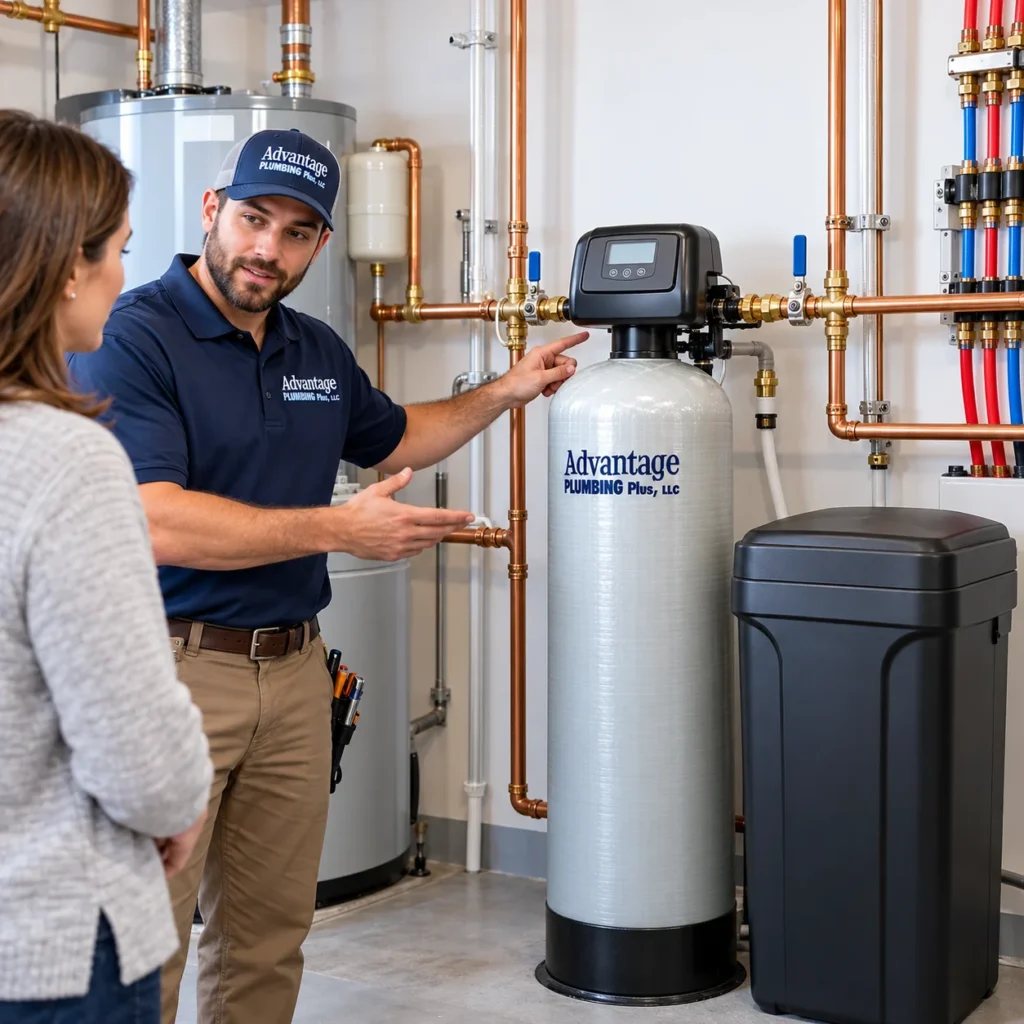
Water Softener Maintenance
Routine maintenance depends on the type of equipment installed and the manufacturer’s requirements.
Salt-based systems may require attention to salt level, salt condition, brine operation, regeneration settings, and other equipment-specific maintenance.
Controls and settings should also remain appropriate for the property’s water usage and treatment requirements.
Maintenance recommendations should follow the actual equipment rather than relying on a universal schedule for every water softener.
If an older system requires increasingly frequent attention, the cost and practicality of continued maintenance can also be considered when comparing repair with replacement.
How Much Does Water Softener Service Cost?
There is no single useful price for every water-softener project because the scope can range from evaluating an existing unit to replacing equipment or installing an entirely new system.
Cost can be influenced by equipment type, capacity, condition of the existing softener, plumbing modifications, installation location, water usage, water conditions, drain access, bypass requirements, replacement needs, and the amount of labor required.
A new installation in a property already prepared for treatment equipment can be different from a project requiring piping changes or a new installation location.
Likewise, servicing one correctable component is different from replacing an older system with multiple deteriorated parts.
A project-specific estimate based on the property and requested service provides a more useful basis for decision-making than a generic national price range.
Call 715-359-7473 or use the Advantage Plumbing Plus contact page to discuss the property and request an estimate.
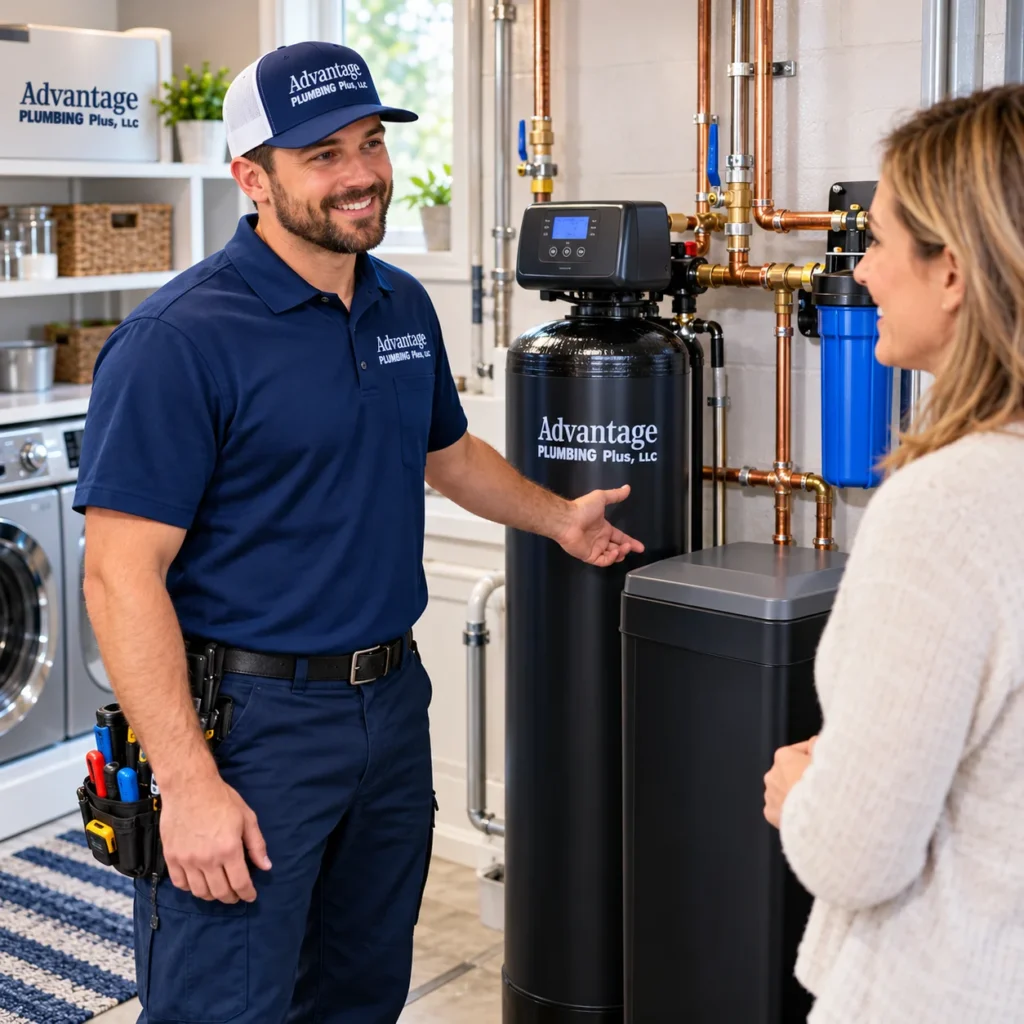
Why Choose Advantage Plumbing Plus?
Advantage Plumbing Plus is locally owned and operated by Ryan Rennie and Keith Krejci and serves Wausau and surrounding Central Wisconsin communities.
The company lists Master Plumber License #904761, connecting water-treatment installation with broader professional plumbing knowledge.
That plumbing background is useful because a water softener must work within the property’s water-supply system rather than functioning as an isolated appliance.
Advantage Plumbing Plus can also address related well-pump, water-heater, piping, remodeling, construction, sump-pump, and other approved plumbing needs when they are relevant to the property.
Qualifying work is backed by a one-year warranty on parts and labor. Customers should confirm how the warranty applies to the specific equipment and work included in their estimate.
The service approach should remain based on the actual property, water concern, and equipment condition instead of assuming that every customer needs the same softener or treatment package.
Customer Reviews
 Posted on Google

 Jeffrey Slachetka
Trustindex verifies that the original source of the review is Google.
We had a great experience working with Advantage Plumbing Plus LLC. Ryan was a very responsive communicator, and the team was on schedule and did a great job. We highly recommend them for your plumbing projects!Posted on Google Melanie BatemanI called Ryan in a moment of frustration after having multiple other professionals not be able to solve my plumbing problem. Ryan was recommended to me by someone else. Ryan arrived at the scheduled time. He took steps that none of the other pros took. He figured out the problem and fixed it... in less than an hour. Highly recommend!Posted on Google
 Gina LehmanHonest plumbers. As a contractor we have worked with them for 14 years. Dependable and competitive pricing.Posted on Google
 Josh WestbergThey did an excellent job with my leaky sewer pipe. Affordable, professional and the cleanup was great.Posted on Google
 David MathiasExcellent, friendly and always on schedule!Posted on Google
 Ashley AshRyan and Keith provided excellent service. They knew right away how to solve our plumbing needs. We appreciated their timely response, great service and pricing! Highly recommend them!! We consider Ryan our #1 plumber!!!Posted on Google
 Austin JonesWe regularly work with Advantage Plumbing Plus on our new construction projects and have had a great experience with their team. They are reliable, communicate well, and keep their work areas neat and organized. They’re always helpful and informative when questions come up, and they do a great job providing clear, accurate estimates. We value our working relationship with them and would confidently recommend Advantage Plumbing Plus to others looking for quality plumbing services.Posted on Google
 Josh BarkleyI have used advantage plumbing plus on all of my new construction builds and they are on schedule when they say they are going to be there. Very neat work and cleanliness during rough in stage. They are very respectable to a completed new home when they do their final trim out. I’d recommend them for all of your plumbing needs.Posted on Google
 Marissa LannbrechtI had a great experience with Advantage Plumbing Plus. They came out quickly, were courteous and knowledgeable, and took the time to explain what needed to be done. The repair was completed the same day and everything works perfectly. Honest, dependable service — I’ll definitely use them again.Posted on Google
 Cagney MartinWe recently called Advantage Plumbing to run plumbing in a new addition. They were priced in our budget, did quick and really professional work. Everything turned out just like we wanted. I’d definitely work with them again!
Frequently Asked Questions About Water Softeners
Mineral scale around faucets or showerheads, recurring spotting on glassware, soap that does not lather as expected, residue on fixtures, and repeated mineral buildup can all be reasons to investigate water hardness
Calcium and magnesium are the primary minerals associated with water hardness. Their concentration affects how hard the water is and how noticeable scale or other hardness-related effects may become.
Start with the water concerns you are actually experiencing. If scale, spotting, soap performance, or mineral buildup is recurring, hardness may be worth evaluating. The appropriate treatment should be based on the property and water conditions rather than symptoms alone.
Existing equipment can be evaluated according to its condition, controls, accessible connections, reported performance, maintenance history, and serviceability. Whether repair is practical depends on what is found.
Age alone does not determine the answer. Equipment condition, repair frequency, component availability, system capacity, water-treatment performance, and repair cost should all be considered.
A whole-home softener is generally connected to treat appropriate indoor water lines downstream of the system. The exact plumbing arrangement may bypass certain outdoor or specialized connections depending on the property.
Reducing hardness minerals can help limit future scale accumulation, but a softener does not repair an existing water-heater problem. Hot-water equipment with performance issues should be evaluated separately.
Yes, water softeners can be used on private-well properties when appropriate for the water conditions. Well pressure, supply reliability, and other water-quality concerns may need to be considered separately.
Not necessarily. Conventional ion-exchange softeners remove hardness minerals from treated water, while other conditioning technologies may address scale differently. The system should be selected according to the desired treatment result and water conditions.
Maintenance depends on the equipment type, controls, water conditions, salt or brine requirements where applicable, usage, and manufacturer guidance. There is no single maintenance schedule that fits every system.
Installation cost depends on equipment capacity, plumbing layout, existing connections, installation location, drain requirements, water conditions, and whether old equipment must be removed or replaced. A property-specific estimate is more useful than one standard price.
Provide the property address, whether the water comes from a private well or municipal supply, the main water concerns, information about any existing softener, approximate equipment age if known, and what you are hoping to improve.
Start Your Water Softener Project in Wausau
If mineral scale, spotting, soap residue, or an aging treatment system is making your water more difficult to manage, the next step is to determine what the property actually needs.
Advantage Plumbing Plus can review your water-softener service request, consider the existing equipment and connected plumbing, and explain appropriate repair, replacement, or installation options based on the approved scope.
Call 715-359-7473 or contact Advantage Plumbing Plus to request a project-specific estimate.
Advantage Plumbing Plus, LLC
147740 County Rd N, Wausau, WI 54401
715-359-7473
advantageplumbingplus@gmail.com
Monday-Friday: 7:00 AM-4:30 PM